
Drone warfare in Ukraine: Behemoth, autonomous interceptors, and drone diplomacy
Four key stories: June 4 - 10, 2026

Ukraine’s middle-strike campaign is in full swing. More than 300 verified drone strikes have disabled Russian air defence systems and targeted infrastructure facilities, warehouses, depots, and military transport. Last week, Ukrainian drones delivered a critical blow to a major logistics route across the Chonhar Bridge, which connects occupied Kherson Oblast with occupied Crimea.
In this edition, we focus on some of the unique unmanned systems used in these operations, as well as a broader analysis of Ukraine’s middle-range strike campaign:
Ukraine’s Behemoth Drone Strikes the Chonhar Bridge;
How Middle-Strike Drones Are Destroying Russian Logistics;
“Drone Diplomacy”: Ukraine Is Launching Drone Deals;
Ukraine’s First Autonomous Interceptor Drones;
and additional developments in drone warfare in Russia and Ukraine.
Thank you for reading and supporting my work!
If you missed it, read my in-depth piece on ground drones for the Defence Procurement International here (page 34). For this article, I interviewed the Third Army Corps’ NC13 — currently one of the leading Ukrainian units in employing ground drones — as well as the Ukrainian company DevDroid.
My earlier reporting on ground drones:
Ukraine’s Behemoth Drone Strikes the Chonhar Bridge
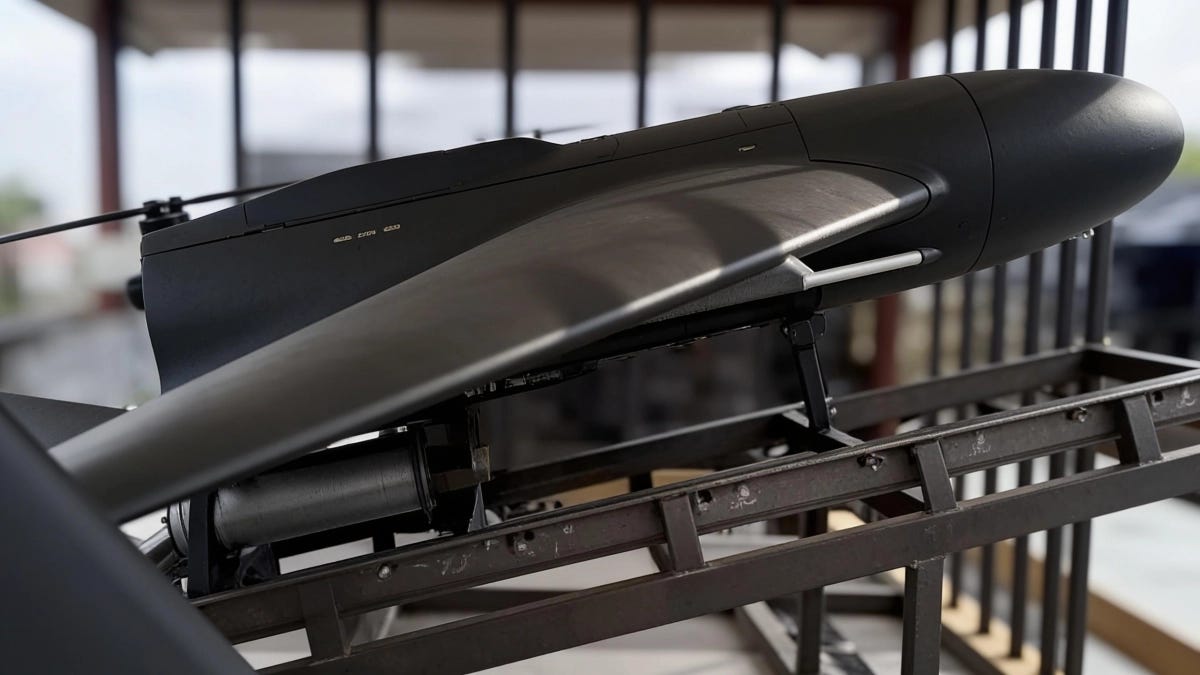
Ukraine demonstrated the first public use of the new domestic Shahed-like Behemoth drone. It is a middle-strike UAV capable of carrying up to 75 kg of explosives over a distance of up to 300 km.
On the night of June 7, these drones were reportedly used for the first time in a raid on a Chonhar bridge, which connects the occupied Kherson region to the occupied Crimea. This route is one of the key logistical corridors used to supply Russian forces on the peninsula.
Russian forces use the bridge to deliver ammunition and fuel from occupied Crimea and supply Russian forces fighting in the Hulyaipole direction (Zaporizhzhia region).
The strike damaged the bridge deck and forced the occupying forces to close a key route to the peninsula. Behemoth was used as part of a strike package alongside FP-2 drones.
Ukrainian forces launched a second strike against the bridge on June 9. According to military sources, the bridge was not destroyed, but it was completely disabled. Transport traffic across the bridge has been blocked.
Ukrainian experts say that for a bridge to collapse, a strike must hit and destroy one of its supports. That is not easy to do. Bridges are best destroyed either through sabotage methods or by a powerful missile strike against the bridge support.
Behemoth was developed by GLEFA and Culver Aerospace and was presented at the Wild Drones exhibition in late May of 2026.
The tandem warhead is the Behemoth’s main advantage among drones of its class. The nose section contains a 40 kg high-explosive fragmentation warhead, followed by a 35 kg thermobaric warhead. The total payload reaches 75 kg, which is a very significant figure for a drone of this format. Russian channels write that this type of warhead is capable of causing critical damage to surface combat ships, as well as to a range of ground fortifications.
The drone’s cruising speed is 170–180 km/h, while its maximum speed is 200 km/h. Its operational altitude in combat mode ranges from 90 to 300 meters. This low-altitude flight profile makes it more difficult for enemy air defence systems to detect the drone.
The preparation time before launch is no more than 15 minutes, which is critically important in fast-moving operations.
Behemoth supports three control modes: FPV, semi-automatic, and fully autonomous.
Connectivity is provided via Starlink. This allows the system to be adapted to different scenarios, from precision strikes with manual guidance to operations under active EW. The developers have also confirmed the existence of a Behemoth Deep Strike version for attacks at significantly longer ranges.
Russian Telegram channels claim that Russia has still not solved the problem of a lack of airborne EW systems capable of suppressing Starlink terminals and blocking video transmission in the 13–40 GHz frequency range.
They also argue that Crimea and Mariupol, including the R-280 highway, urgently require a full-fledged counter-drone “umbrella” based on automated anti-aircraft machine-gun turret systems such as Citadel and Zubr, as well as several hundred Verba MANPADS teams dispersed around the outskirts of populated areas. They also call for large numbers of inexpensive UAV interceptors, such as Lis-2 and Molniya-2P, receiving target designation from airspace surveillance radars.
The post states that there is currently an acute shortage of Pantsir-S1/S1M and Tor-M2 systems, as well as lighter air defence assets, along the Crimea–Azov operational direction, and argues that this gap must be addressed as quickly as possible.
According to Ukraine’s Ministry of Defence, enemy air defence assets and radars are among the key priority targets for their middle-range strikes. In April 2026, Ukraine’s Defence Forces destroyed almost twice as many air defence systems and radars as, for example, in October of the previous year.
How Middle-Strike Drones Are Destroying Russian Logistics
According to Oboronka’s calculations, during the first year of middle-strike drone operations, Ukraine’s Defence Forces reported more than 365 confirmed strikes with video evidence. Most of them targeted Russian air defence systems — 172 confirmed strikes. Other targets included 48 deployment points, 35 energy infrastructure facilities, 42 warehouses, and 31 aviation-related targets.
Here is a summary of the article by Ilya Volynsky for Oboronka: