

Operation Spiderweb is a manual in asymmetric warfare. In June 2025, many of us were stunned by videos showing hundreds of small FPV drones striking Russian strategic aircraft one by one. Over the past year, I have published several reports and summarized a number of articles on Operation Spiderweb.
Today, I will recap some of this information, complement it with recent updates, and present the emerging concept of remote drone warfare.
I’ll start this post with an excellent summary by the 413th Regiment of the Unmanned Systems Forces of Ukraine:
On June 1, 2025, Ukraine’s Security Service (SBU) conducted the unique Operation Spiderweb, reportedly targeting 34% of Russia’s long-range aviation, including Tu-95MS and Tu-22M3 cruise missile carriers, A-50 airborne early warning aircraft, and Il-78 tanker aircraft.
The operation was remarkable not only because of the scale of Russian losses, but also because of the method used. Trucks carrying camouflaged FPV strike drones approached key Russian strategic aviation airfields, including Engels, Olenya, and Belaya. The drones then struck the aircraft from extremely close range. In the Amur region, the plan failed when the drone-bearing truck bound for Russia’s Ukrainka base caught fire on the highway.
According to open-source reports, the strike involved First Contact’s Osa FPV drones, which are known for their reinforced frame and AI-based targeting system.
Russia tried to conceal the scale of its losses, as the strike targeted its strategic aviation and reportedly affected nearly a third of Russia’s strategic aircraft capable of carrying nuclear weapons.
Open-source information suggests that Russia may have lost up to 15 Tu-95MS strategic bombers, or around a quarter of its entire fleet of this aircraft type.
As a result, Russia’s use of Tu-95MS aircraft for strikes against Ukraine reportedly declined by at least 20–30%.
The use of Tu-22M3 bombers after Operation Spiderweb became very rare — roughly once every six months — likely due to losses sustained during the operation.
The SBU estimated Russia’s losses at around $7 billion. However, the financial cost is not the main issue: Russia can no longer produce new Tu-95MS or Tu-22M3 aircraft, meaning any losses of these platforms are irreversible.
Operation Spiderweb also served as a warning to the United States. It demonstrated that even American strategic aviation could potentially be disabled by simple AI-enabled FPV drones, making Ukraine’s combat experience especially valuable.
Finally, Operation Spiderweb became a kind of prologue to the wider use of artificial intelligence in the current drone war.
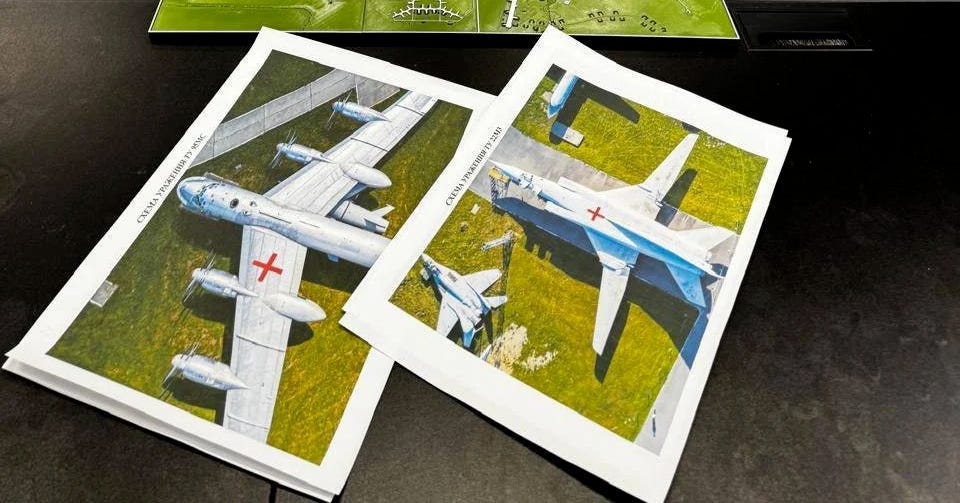
(AI technologies were reportedly used for terminal guidance. Among other methods, the AI was trained to recognize target features on real aircraft displayed in Ukrainian museums).
Read my 1-year-old article on Operation Spiderweb.
Damage Assessment
Russia’s Ministry of Defence estimated the damage at 2 billion rubles ($26 million). However, this figure appears low, as even the loss of a single Tu-95 would cost far more; 2 billion rubles is closer to the estimated cost of a Su-34. According to this account, Russian Aerospace Forces losses from Operation Spiderweb amounted to seven Tu-95 bombers and four Tu-22M3 bombers.
According to Ukrainian official communication, Operation Spiderweb destroyed or damaged at least 41 Russian aircraft, with estimated Russian losses of around $7 billion.
How the Operation Was Carried Out
According to the WSJ report, President Zelensky tasked the SBU with disrupting Russia’s strategic aviation, which was used for missile strikes against Ukraine.
The SBU chose an asymmetric approach: smuggling small FPV drones into Russia to strike high-value aircraft at airbases.
It took the SBU 18 months to prepare this operation under conditions of absolute secrecy. According to the creator of the Osa FPV drone, Valeriy Borovyk, even the drone development team was not told the real purpose of the operation.
The drones were transported in parts, assembled inside Russia, and launched from concealed cabins with batteries and solar panels.
The young couple (Russian citizens of Ukrainian origin) recruited by the SBU reportedly assembled the systems in a rented warehouse in Russia. Following instructions from Ukraine via audio and video calls, they spent hours assembling around 150 drones and eight mobile cabins for transport and launch.
The drones were hidden under the cabin roofs, which were mounted on trucks. At the right moment, the roofs opened remotely, allowing the drones to launch and attack Russian aircraft.
Five trucks were used to transport the eight cabins, although one failed to reach its destination.
Experienced Ukrainian drone pilots were pulled from the front line and underwent intensive training, without initially being told the final targets. They learned the actual targets only on the day of the operation.
Once near the airfields, operators in Kyiv took control through local cellular networks and onboard camera feeds.
In total, 117 drones were launched.
The Concept of Remote Drone Warfare: The First Contact
The drones used in this operation looked like ordinary FPV drones, yet they were unique. Cheap drones, which are now being widely used on the front line, cannot be employed to carry out such complex operations deep inside enemy territory.
In an exclusive commentary to Ukraine’s Arms Monitor in August 2025, Valeriy Borovyk from First Contact, said that such drones are primarily designed for specific operations — they are tested for a long time, redesigned multiple times, and many pilots are trained to operate them. They are only one part of a larger machine involving special groups, officers, and agents. In the end, the drones must strike precisely and not fail those who prepared the mission.
Last week, Valeriy published an article on the first anniversary of the operation. In it, he argues that Spiderweb demonstrated the emerging concept of Remote Drone Warfare — a model in which trained drone operators can conduct combat missions from afar, without being physically present at the battlefield.
Key points from the article:
Before Operation Spiderweb, Ukrainian units had already tested a model in which FPV pilots did not need to deploy directly to the front line. Instead, drones could be activated near the combat zone, while trained operators carried out missions remotely from safer locations.
Operation Spiderweb applied this approach at a much greater scale and complexity. It demonstrated that strike drones could be controlled remotely by pilots located thousands of kilometres away from the target.
According to Borovyk, this experience revived an idea that had seemed almost unrealistic at the beginning of the full-scale war: a system in which drones are positioned near the line of contact, while operators from different locations — potentially even different countries — conduct missions in real time.
Borovyk describes this as a new type of warfare, where technology reduces the importance of physical distance between the battlefield and the person participating in combat.
Remote-control systems are no longer just being developed and tested — they are already entering active use. The goal is not only to increase operational effectiveness, but also to reduce dependence on scarce personnel.
Ukraine has already used interceptor drones against Shaheds, with pilots controlling them remotely from thousands of kilometres away.
Remotely operated turrets are also being used in short-range air defence, allowing operators to work from protected locations.
Naval drones are already operating successfully and can be controlled by crews located even in another country.
The First Contact team is discussing with Ukraine’s Air Force Command and the Main Directorate of Electronic Warfare and Cybersecurity the automation of movement and control for air defence and EW systems mounted on ground robotic platforms, copters, and remotely controlled vehicles.
The First Contact has been working for several months on developing and implementing a full Remote Drone Warfare concept.
The core idea is to create a model in which a significant share of combat tasks can be performed by trained remote operators without their physical presence in the combat zone.
Such a system could change the logic of mobilization, lower the psychological barrier to participation in war, reduce fear of death, and expand the number of people who can contribute to national defence regardless of age, gender, or physical condition.
Main elements of the concept:
Creating a network of remotely controlled strike and reconnaissance systems positioned in areas most suitable for mission success.
Scaling the “Spiderweb” principle across the entire line of contact, as well as for sectoral and object-based defence. This includes the idea of so-called “fly-boxes” — platforms with drones that can be placed in fixed or mobile positions, remain on standby, and be activated when needed.
Building reliable and protected communication systems for remote drone control. These systems would need redundancy, encryption, and multiple backup channels.
Testing, scaling, and integrating technical solutions into a unified battle management system, potentially including situational awareness tools.
Ensuring strict control over who is actually operating a drone in real time. Borovyk highlights the need for identity verification, biometric checks, operator-status monitoring, and protected control systems to prevent unauthorized access or misuse.
Overall, Borovyk presents Operation Spiderweb not only as a successful strike on Russian strategic aviation but also as a proof of concept for a broader transformation in drone warfare.
The Operation showed that even countries without nuclear weapons or other powerful strike capabilities can inflict painful damage on one of the world’s leading military powers. More importantly, such operations can target the means of weapons delivery, which changes the logic of deterrence itself. Even the most powerful weapons may remain on a state’s territory if it cannot deliver them to their targets.
Read relevant articles:
How Ukraine’s Operation Spiderweb Affected Russia’s Strategic Bomber Fleet;
(Un)Manned Warfare: 80% of Drone Success Depends on Pilot Skill.
To stay up to date on the latest developments in unmanned warfare in Ukraine, subscribe to my new product, Ukraine Drone Brief, available to VIP-tier subscribers.
I have been wondering why they haven’t done something similar since.
As great as this is for Ukraine it should make all countries concerned.