

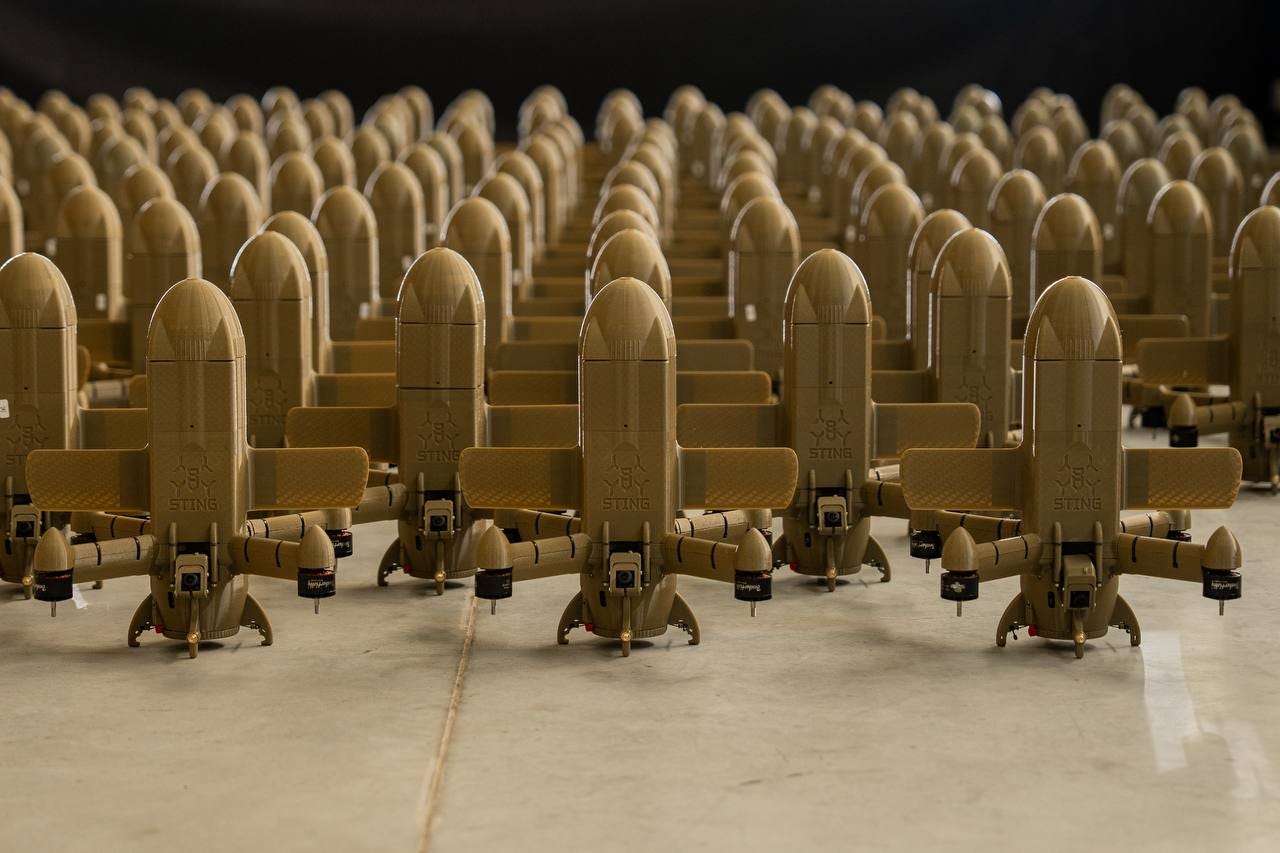
Are interceptor drones already autonomous? Can a pilot sitting in Ukraine intercept Shaheds in the Gulf? Is it enough to buy hundreds of these systems from Ukraine to protect your own country’s facilities? I discussed some of these questions with the operator of STING drones, one of the most effective Ukrainian interceptors produced by Wild Hornets.
The article is available to all readers — enjoy reading it, and feel free to share it with your network.
There are more than 100 manufacturers of interceptor drones in Ukraine. As Ukraine offers its expertise in countering aerial threats to partners worldwide, this segment of the industry is growing rapidly. At the same time, only a handful of producers have achieved truly significant results.
One of them is Wild Hornets, a group of engineers that developed the STING interceptor and the Hornet Vision Ctrl control system, which enables remote piloting of interceptors. In May, STING drones intercepted over 3,000 aerial targets.
STING is a lightweight interceptor drone with a cruising speed of 140–170 km/h. In August 2025, Wild Hornets released a video showing tests of a faster version of STING that reached 315 km/h.
It operates at altitudes up to 5,000 m (maximum 7,000 m) and can climb at 30 m/s. Its maximum flight distance is 37 km, while its tactical radius with return is 18.5 km. Flight endurance ranges from around 6 minutes at maximum speed to up to 15 minutes at cruising speed. The exact flight distance, radius, and endurance depend on battery capacity, weather conditions, payload weight, and the operator’s flying style. The drone carries a 500 g payload.
I interviewed an experienced Ukrainian interceptor drone pilot, callsign Gorn, who shared his thoughts on the STING system and the latest trends in this segment. We covered topics such as:
the use of STING drone and Hornet Vision Ctrl system;
autonomy in interceptors;
trends in Ukraine and globally;
common misconceptions about interceptor drones.
Regular FPVs vs Interceptor Drones
Gorn began his path in this field as a regular FPV drone pilot before moving on to interceptors. According to him, interceptors represent an entirely different level of complexity compared to regular FPV drones.
An interceptor drone often operates in a vertical position, and when guiding it toward a target, another coordinate is added: altitude. While this may not seem too difficult in theory, in practice it has a major impact on the piloting process.
He explained that with regular FPV drones, pilots are often guided visually. With interceptors, however, they rely heavily on radar data and may only have an approximate understanding of where the target is. Detection accuracy is not always perfect, speeds are very high, there are many variables, and the time available to make a decision is extremely limited.
In his words, the logic of operating interceptor drones is already closer to piloting conventional aircraft than to classic FPV. The pilot has to quickly assess the situation, understand where the target is, how it is moving, how the drone itself is moving, and make decisions almost instantly.
Gorn said it may take about a week for an experienced pilot to transition to an interceptor drone and learn how to take off. But these skills can be refined endlessly, and a good pilot has to train constantly.
STING Drones and Hornet Vision CTRL
Talking about the specifics of working with STING interceptors, the pilot said that one of STING’s main advantages is its low entry threshold for pilots. This is achieved through the platform's stability and the engineers’ competence. The drone behaves predictably, remains stable, and is easy to control.
“Compared with many other systems, STING is as stable as possible,” he said. “It can maintain its maximum speed for quite a long time — essentially for as long as the battery allows”.
In late June 2026, Ukraine’s MoD codified the Hornet Vision Ctrl system, which allows pilots to remotely control drones from anywhere in the world. It was officially unveiled in March 2026. Thanks to this technology, more than 600 targets have been destroyed remotely in less than three months.
Also, Wild Hornets announced that the Hornet Vision Ctrl system allowed them to set a new distance record for controlling STING. According to the company, the pilot was located abroad and controlled a drone operating in northern Ukraine, around 2,000 km away from him.
In a major interview with DOU, a Wild Hornets representative said that the control system is a key component of interceptors’ effectiveness. Hornet Vision Ctrl emerged because of a shortage of Chinese digital systems. “We were forced to create our own system. It is not just about data transmission. It is about remote control, positioning, AI systems, and controlling different drones from different platforms — in the air, on land, and at sea,” the representative mentioned, speaking on the condition of anonymity.
The system includes a ground command-and-control station with a digital video system, a 360-degree omnidirectional antenna, and equipment to connect to the UAV operator’s workstation.
The main advantage of the Hornet Vision antenna is 360° coverage, which allows two-person crews to operate without a separate operator to turn the antenna. Another feature is one-way communication, which increases the system’s resilience to EW.
Gorn told me that he had worked with the Hornet Vision Ctrl within Ukraine, and that his experience with the system was highly positive. He described it as a very promising technology. “One of its major advantages is that a single crew can cover several positions. One pilot is enough to cover part of the front, while only spotters need to remain on the ground. They are much easier to train, and this does not significantly affect the quality of the mission,” Gorn said.
He noted that there is some control latency — around 0.2 seconds — but in practice it feels lower and is barely noticeable. After one or two flights, the pilot effectively stops noticing it.
Gorn also emphasized that distance itself is not the key factor limiting this type of remote control. If the system is built properly, geography is not the problem.
Interceptor Drones and Autonomy
There are several ways in which autonomy and AI-based technologies can be used to intercept aerial targets.
In January 2026, the Ukrainian government, together with the U.S. company Palantir, launched Brave1 Dataroom to test and train AI models. At the initial stage, this project focuses on developing autonomous technologies to detect and intercept enemy drones. The platform enables Ukrainian defence companies to train, test, and validate their own AI models. As of June 2026, more than 100 Ukrainian companies gained access to Brave1 Dataroom and are using the platform to train AI models using real-world data.
Several Ukrainian companies have been working on AI modules for interceptors. The Fourth Law developed a TFL Anti-Shahed module that automatically guides interceptor drones toward Shahed-type drones.
Gorn said that, as of now, automatic terminal guidance in interceptor drones is not yet widespread, but the trend is clearly moving in that direction. All manufacturers are working on this capability.
He explained that these systems are still being built, tested, and improved. The operating principle is more or less the same across different systems, but the key issue is stability. “We need to know that the system can be relied on,” he said.
According to the pilot, this requires a large number of tests. The system has to work consistently in different conditions, and only then can it be truly scaled.
Wild Hornets is also working to integrate AI into its STING and has established a dedicated engineering team for this effort. The company says that external developers often have strong software expertise but lack real-world battlefield experience.
The main purpose of AI integration is not to replace the operator but to assist with target search and navigation under complex, high-speed conditions. A last-mile guidance function is also planned as part of the wider Hornet Vision ecosystem.
According to the company, AI integration could cost around $150–500 per drone, depending on functionality. The main costs are hardware and labour, while software should become cheaper with scale.
Interceptor Trends in Ukraine and Globally
Gorn said that, globally, everyone wants automatic “fire-and-forget” systems — systems that do not require a qualified pilot, in which a person simply presses a button and the technology does the rest. He said this is understandable, because no one wants to train large numbers of people.
However, in his view, fully removing the pilot from the process would be a step too far. The pilot should remain involved, and control over the drone should be preserved.
He noted that, for now, such systems do not pose a direct threat to civilian aviation — neither in terms of altitude nor speed. But the field is developing very quickly, and it needs to be closely monitored.
According to Gorn, the main trend in Ukraine is the speed of interceptors. Everyone is trying to increase the speed of these drones, and jet-powered variants already exist.
As Ukraine’s Commander-in-Chief Syrsky informed, Russia plans to raise the share of jet-powered attack drones to 50%. According to a report by Militarnyi, Ukraine currently lacks a systematic solution for jet-powered drones. If a jet-powered enemy drone is flying at more than 300 km/h while the interceptor is moving at 310 km/h, the speed advantage is insufficient.
For effective interception, the drone needs to be around 25% faster than the target. At current performance levels, if the interceptor detects the target in one region, it may only be able to catch up with it in the neighboring region. Interceptor drone batteries are not designed for flights over such long distances.
To respond to this threat, Wild Hornets developed STING 2.0, which is faster than the previous version. According to the company, the goal was not to exceed 400 km/h, as this would offer little practical benefit. Instead, STING 2.0 is designed to be just fast enough to catch targets, including jet-powered Shaheds, while retaining enough endurance to search for them.
Common Misconceptions About Interceptors
Since this is a new and rapidly developing niche, many myths surround interceptor drones.
Gorn told me that one of the biggest mistakes is treating an interceptor as a regular FPV drone. It is not enough to take an ordinary FPV pilot, put them behind new equipment, and expect results. “It does not work that way. You need a qualified crew,” he said.
Another misconception, according to him, is that everything is already automated. In reality, almost everything is still controlled by people. This is the work of a crew, not simply an autonomous system.
He explained that the classic operating model consists of a crew comprising a pilot, a navigator, and an explosives specialist. Without control and coordination, the system does not work as intended.
A Wild Hornets representative told DOU that people often imagine the process of downing enemy drones as simple: press a button, the drone takes off, and it intercepts a Shahed. But reality is still far from that.
For an interceptor to take off and destroy a target at the press of a button, it would need to receive precise coordinates very quickly amid electronic warfare, spoofing, fog, communication problems, unstable Starlink, and many other factors.
Once this is achieved, the human role in the interception process will decrease. For now, however, the operator remains at the centre of the process — and will remain there for a long time.
And again, this reinforces the point I have tried to make throughout my reports: it is not enough to simply produce or procure drones. It is even more important to train qualified operators.
If an experienced combat drone pilot needed about a week to transition from FPV drones to interceptors, then significantly more time and resources should be dedicated to training people with limited knowledge of drones and no combat experience.
Read my earlier report on this topic: (Un)Manned Warfare: 80% of Drone Success Depends on Pilot Skill.
And the report by Oliver Gill and Jack Matlack for LSE Ideas: "Teaching Humans in the Loop: Supporting and Integrating Ukraine’s Unmanned Systems Training into Europe’s Security Architecture".
My previous reports on interceptors:
Interesting,as always!
Great report. Thank you.